A 2013 Lille kit warehouse is not an RGE rooftop contractor
Mon Kit Solaire, styled MonKitSolaire on some pages, sells at monkitsolaire.fr from 60 rue de Londres, Bâtiment G, 59000 Lille. The company dates itself to 2013 as an early French web shop for self-install autoconsommation kits. The operating model is warehouse assembly: panels, micro-inverters or string inverters, AC protection enclosures, cables, and a production-monitoring module are packed for pallet delivery by appointment, typically described as one to four weeks. Contact sits at contact@monkitsolaire.fr. That is kit retail. It is not Enedis, not Consuel, and not the electrician who will sign a full-roof commissioning file. If you need someone on the tiles with a décennale insurance stamp, you are shopping a different job—even when the same site mentions a partner installer network for larger projects.
300–800 W balcony plug-in versus a south roof that needs rails and a ladder
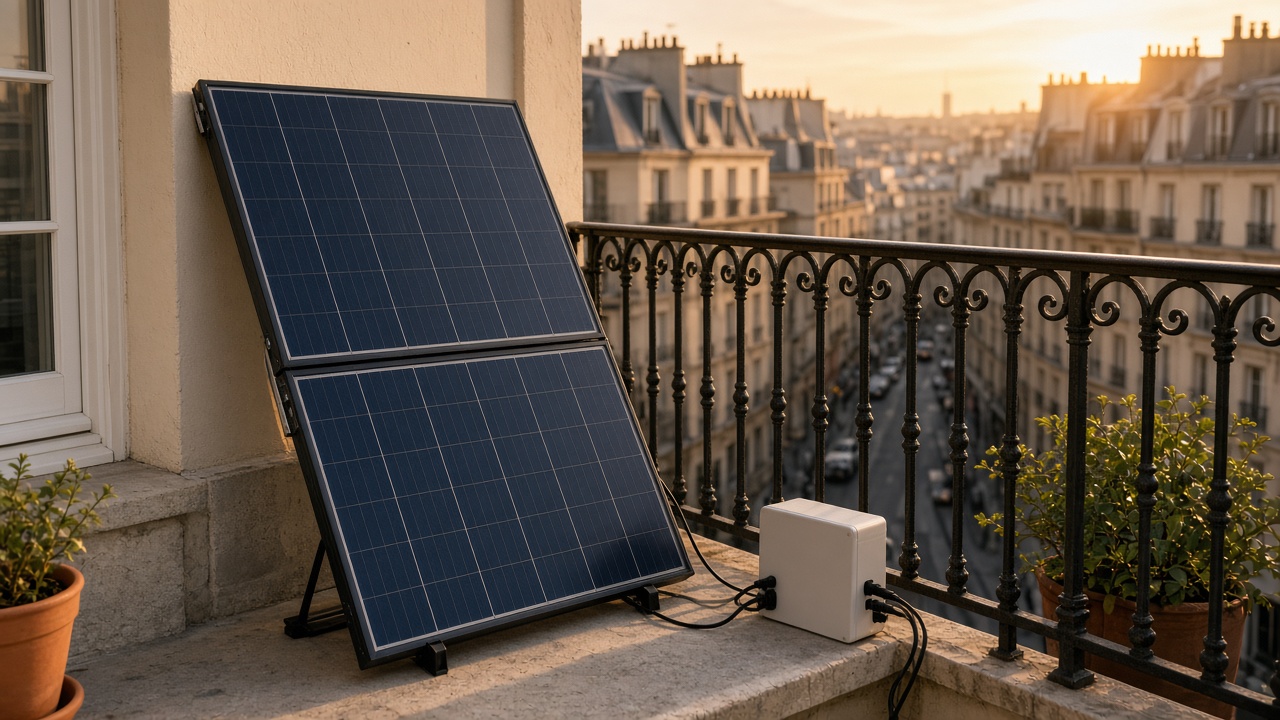
French households now split into two very different carts. Balcony and terrace plug-in kits in the roughly 300–800 W class use a micro-inverter to 230 V and a domestic socket, aiming at the household’s always-on load—fridge, box, standby—rather than exporting a business plan. Output is modest; orientation, shade from the building opposite, and how many hours you actually consume while the sun is up matter more than the peak-watt sticker. Full roof kits on the same shop run from small self-install packs into several kilowatts, with Dualsun and other module brands appearing in “French kit” ranges, plus Enphase, APS, Fronius, and similar inverter names on larger lists. Those roof packs still assume you can lift glass, weatherproof penetrations, and live with a DC string until the AC side is correctly protected.
Mounting is a second SKU family, not a free extra. The catalogue talks rail kits for pitched tile, ballast frames for flat roofs and terraces, façade brackets, garden ground mounts, and even pergola geometry. A balcony rail clamp is not a tile hook. North-facing deep shade, a courtyard that only sees winter sun, or a plane tree over the terrace will waste a high-efficiency cell. Measure azimuth and horizon before you configure watts. MonKitSolaire’s pre-wiring in Lille reduces connector guesswork; it does not flatten a north wall into a production site. If the only sunny surface you control is a rented balcony, stop at a plug-in kit and landlord permission rather than ordering a 9 kWc roof set because the configurator allowed it.
- Lille assembly and pallet shipping in France; typical handling window cited in weeks, not next-day parcel
- Plug-in balcony/terrace kits in the few-hundred-watt class versus multi-kilowatt roof packs on the same domain
- Micro-inverter or string inverter plus AC protection box and monitoring dongle included in kit logic
- Fixings sold by surface: tile rails, flat-roof ballast, façade, ground, garden—not one universal bracket
- Optional partner-installer path for people who do not want to drill; still a separate contract from the web cart
- Support is kit retail: missing MC4, inverter pairing, and delivery slots—not a site visit to your Linky
Enedis CACSI, the Linky meter, and the Consuel line you should not invent past
Anything that can push current toward the public network has to be known to Enedis. For small autoconsommation without a surplus-sale contract, the usual file is a convention d’autoconsommation sans injection (CACSI), filed online with your point-of-delivery reference from a bill. The form is free. Skipping it because a balcony kit “is only a plug” is how households end up with an undeclared generator on a feeder a technician may work on. A Linky meter is the standard metering setup on the connected public network; isolated off-grid cabins are the exception, not Paris balconies. This guide will not quote kilowatt-hour tariffs, buy-back rates, or “two-year payback” banners from the shop. Those numbers move with the regulated tariff, your supplier, and whether you actually self-consume.
Consuel attestation is the conformity paper electricians associate with larger photovoltaic plants. Plug-in kits under common power thresholds are often discussed online as exempt from a full Consuel visit, with tighter paperwork as you climb toward a few kilovolt-amperes and a hard requirement above the classic 3 kVA class. Thresholds and affidavits change; read Enedis and Consuel notices for the year you install, not a 2021 blog comment. Urbanisme is separate: a panel that changes a façade or sits in a protected area can need a déclaration préalable even when the electrical file is a CACSI. Copropriété rules can block rail clamps on a garde-corps even if Enedis would accept the watts. MonKitSolaire can ship a certified micro-inverter; it cannot vote at your assemblée générale.
Match balcony plug-in versus roof rails on the live configurator, then write down inverter brand and peak watts for the Enedis form before you pay.
Open MonKitSolaire kit families by watts and mounting →Inverters, Dualsun modules, and what “kit français” does not guarantee
Kit pages mix imported cells with European assembly stories. Dualsun appears as a French-branded module option in dedicated collections; micro-inverters from names such as TSUN, APS, or Enphase show up depending on the pack. A “kit français” label usually means a commercial assembly and a named module line, not that every wafer was pulled in Grenoble. String inverters (Fronius and peers on larger lists) suit a roof with even strings; micro-inverters suit a balcony where one panel may sit in a chimney shadow. The AC protection enclosure is the piece amateurs skip and electricians notice. If your house is three-phase, do not checkout a single-phase balcony SKU and hope the Linky sorts it. The Lille warehouse pre-cables a lot; it does not rewire your tableau.
MonKitSolaire is a pallet of glass and electronics from Lille. The hard part is still shade, copropriété, and the Enedis form. If you wanted a turnkey roofer with Consuel in the quote, you opened the wrong cart.
— Alex Rivera
Beem, Sunology, and the local RGE installer are three different invoices
Beem popularised a compact balcony aesthetic and a consumer app; Sunology’s PLAY-style units compete in the same plug-and-play aisle with their own micro-inverter pairing. Both are brand-led kits with strong retail packaging. MonKitSolaire is closer to a component warehouse that will also sell you tile rails and a 6 kWc layout if you insist. Price-shop the same watt class, but compare mounting hardware, inverter warranty years, and whether pallet delivery includes a booked timeslot to a third-floor courtyard. A local RGE installer is the third path: labour, scaffolding, Consuel, and often access to surplus-sale paperwork that a plug-in kit never sees. National self-consumption primes that attach to obligation-d’achat plants generally do not follow a 400 W socket kit; do not budget a subsidy you have not confirmed on a government page.
- Skip if you rent and the landlord or syndic has not approved visible panels or rail clamps
- Skip if the only surface is north-facing or in deep courtyard shade for most of the day
- Skip if you want a turnkey full roof with scaffolding, Consuel, and a single installer invoice
- Skip if you refuse to file CACSI and treat Enedis as optional because the kit “just plugs in”
- Stay if you can ballast a south terrace, lift a panel with a second person, and book the pallet slot
- Stay if you need spare MC4 stock and a French-language kit desk rather than a marketplace listing
FAQ: copropriété, surplus, shipping, and who comes when the micro-inverter blinks
Does a balcony kit mean I can skip the mairie and the syndic?
No. A panel sitting in a planter on a private terrace is the simplest visual case, and even then Enedis still wants the CACSI. Clamping to a garde-corps, drilling a façade, or altering a roof plane can trigger règlement de copropriété votes and a déclaration préalable. Historic fronts and lotissements with strict cahiers des charges are stricter. MonKitSolaire’s product photos are not a planning permission. Photograph the elevation, read the copropriété minutes, and only then pick ballast versus brackets. If the syndic says no, a cheaper Beem unit will not make the railing legal. Electrical smallness does not erase urbanisme.
Will Enedis pay me for the extra watts my balcony cannot use at noon?
Not under a standard sans-injection convention. CACSI is structured so you consume locally; surplus that leaks to the network is not a mini EDF OA contract. Full plants with obligation d’achat are a different legal object, usually with Consuel, a producer contract, and installer paperwork. Do not size an 800 W kit on a fantasy of selling kilowatt-hours. Size it on the loads that run while the balcony is in sun. This article will not invent a feed-in tariff. If surplus sale matters, you are in installer-and-contract territory, which may still use hardware from the same warehouse but is not a plug-in checkout.
Who shows up if the pallet is late or a panel arrives cracked?
The shop and its freight partner. Pallet delivery is appointment-based because glass does not go in a letterbox. Note damage on the delivery tablet before the driver leaves; hidden cracks found after the truck is gone are harder. After-sales for pairing a micro-inverter or replacing a dongle is email and phone to Lille, not a dispatched electrician. If you bought through the partner-installer route, labour warranty follows that installer, not the web FAQ. Keep the packing list; kits have many small SKUs. A cracked module is a freight claim. A miswired tableau after you ignored the AC enclosure is your electrician’s invoice.
Is MonKitSolaire cheaper than Beem only because it is “wholesale”?
Sometimes the watt is cheaper; sometimes you are paying for rails, a bigger inverter, and a pallet. Beem and Sunology sell a designed object with a consumer unboxing. MonKitSolaire sells a bill of materials that can look messy in the courtyard and more complete on a roof. Compare identical peak watts, inverter brand, and mounting, including whether you must buy ballast trays separately. Ignore “rentable dès 2 ans” style homepage claims; your bill depends on self-consumption share and the tariff you actually pay. If the Lille kit is missing a part the Beem box includes, the sticker saving evaporates. Read the packing list like a tradesperson, not like a slogan.
Can a renter take the kit to the next flat?
A plug-in balcony set with ballast or free-standing feet is the only geometry that reasonably moves. Rail kits that pierce tiles or façades become the landlord’s problem and often stay. You still need permission at both addresses, a new CACSI if the delivery point changes, and intact connectors. Do not drill a rented garde-corps because a video made it look reversible. If you move every year, the honest alternative may be no kit, or a single panel you can carry down the stairs. MonKitSolaire will sell what the configurator allows; it will not store your panels between leases.
Only proceed if orientation, syndic or landlord, and the Enedis CACSI path are clear; then pick watts and mounting on the French shop.
Configure a MonKitSolaire kit after you check shade and permission →Verdict: buy glass from Lille only after the paperwork and the sun path agree
MonKitSolaire is a serious French kit merchant for households that can assemble, file CACSI, and live with pallet logistics. It is the wrong tab if you rent without consent, face north shade, or want a single installer to own Consuel and the roof. Beem and Sunology remain cleaner balcony objects; a local RGE crew remains the path for a full plant. If you still want the Lille bill of materials, match mounting to the surface you actually control, write the inverter reference down for Enedis, and treat after-sales as a shop desk—not a man in a van.