A Marietta cutter that ships windows, not a same-day frame counter
Matboard and More LLC is a Georgia cutter of custom picture mats and framing supplies, not a mall counter that mounts your print while you wait. The contact page lists 1791 West Oak Parkway, Suite 7, Marietta, GA 30062, phone 678-688-MATS (6287), email info@matboardandmore.com, live chat when staff are available, and a form answered by the next business day. Trustpilot and a 2018 founder interview date the business to 2012. Existing orders are tracked in a signed-in account. The FAQ says goods are assembled and shipped from the Atlanta-area facility, with U.S. suppliers except a few Italian frames. Treat the suite as production space unless the company confirms a public visit.
On 20 September 2026 the homepage still listed pre-cut mats and custom frames in any size, color, and quantity, plus backing boards, clear bags, show kits, value packs, and custom plexiglass. The builder is the product: you type an outer size that matches a rabbet or a sheet of glass, then an opening that sits on the art. Uncut sheets use No Opening or 0 x 0 inches. Boards stop at 32 by 40 inches because, the FAQ says, larger sheets cost too much to ship. Ovals and multi-openings are quoted from a labeled drawing. That mix suits odd print sizes; it does not replace a conservator.
Berkshire, Decorative, and Conservation Select are not the same board
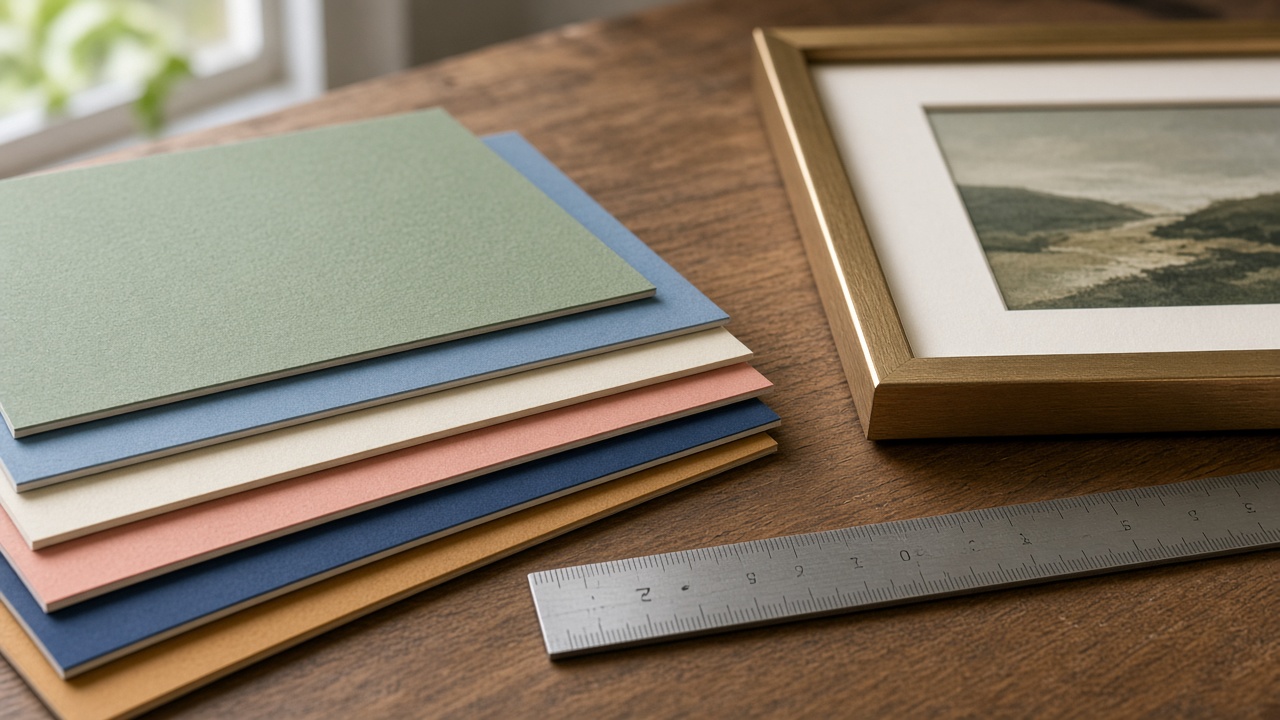
The FAQ prices mats by family, core, outer size, and quantity, not by the color name you click. Berkshire is the economy line at about 0.040 inches; the art-show guide warns of less clean cuts, faster fade, and less depth. Decorative and Conservation boards are listed near 0.052 inches. Conservation Select is the buffered wood-pulp board the shop treats as acid-free. Matboard 101 is explicit that Berkshire and Decorative surfaces are not. True cotton museum board is described as a different fiber for work that must last centuries, and the primer does not present it as a stock cart item. A Conservation click is not a museum hinge.
Core is the bevel after the 45-degree cut, which the FAQ says is default on every opening. Standard cream cores cost less and, the company warns, yellow over a decade or more in light and can turn brittle. White and black cores are sold as acid-free cores that keep their color; they still sit under a surface that may not be Conservation. The art-show tutorial names Polar White, Smooth White, Off White, Very White, Arctic White, Antique White, White Art, and 8-ply White Art as the whites people reorder. About 80 percent of show work, they say, is still plain black or white. Screen swatches lie, which is why samples exist.
- Berkshire: about 0.040 in; lowest price; the art-show guide steers it away from juried galleries
- Decorative: about 0.052 in; not an acid-free surface on Matboard 101; typical for household art
- Conservation Select: buffered wood-pulp board the shop calls acid-free; pair it with archival backing
- Conservation 8-ply: listed as the thickest mat; closer in depth to stacked 4-ply layers
- Cores: cream/standard (will yellow), white, or black; openings are 45-degree bevels unless you arrange a special cut
Outer size, opening, and the overlap you must not skip
The measuring guide is the page that prevents most bad orders. Outer size is the frame size: it must match the glass, or the inner rabbet, of the moulding you already own. Artwork size is the image you want to see, not leftover paper. Opening size is the window; make it about one-quarter inch smaller on each side so the mat overlaps the art for tape. If you have a frame, measure the glass. Do not guess from the outside of the wood. If you still need a frame, the help pages push standard outers such as 5x7, 8x10, 11x14, 16x20, and 18x24 inches so a store-bought moulding still fits. Inner opening does not change price. Outer size does.
Borders of two to three inches are the default advice; the art-show article stretches that to two to four inches and calls a one-inch border almost never enough. A 12x12 inch mat with a 5x5 inch opening is their example of a wide margin. Double mats add an accent layer whose reveal is usually one-quarter inch. Matboard 101 says the shop tapes those layers at no extra charge. Offset, including Top Center, makes the bottom margin heavier; a half-inch shift is enough for most 8x10s in 11x14 frames. Cart margins already include the reveal on a double mat. Wrong numbers here are cut into board you cannot uncut.
Check live outer sizes, cores, and volume pricing on matboardandmore.com before you commit to a Conservation cut.
Open the Matboard and More builder →Who should order here, and who should book a local framer
This shop fits people who already know the glass size, can use a ruler, and want a cut mat shipped rather than a design consult. Photographers who sell work in show kits, households matching odd openings to old frames, offices that need a stack of the same window, and B2B buyers who can send a purchase order are the audiences named on the FAQ. Volume discounts start at quantity two and, per the FAQ, can reach 76 percent on the published price list. There is no minimum order. A poster, a student watercolor, or a run of identical 8x10s is the cheaper path here. Government and museum terms require a direct contact.
Skip this cart when the object is irreplaceable and you need someone to hinge it in front of you. A local framer still wins for canvas thicker than the rabbet, work larger than 32 by 40 inches, glass instead of plexiglass, multi-opening designs you cannot draw, and same-day deadlines. Canada is excluded from shipping. Alaska, Hawaii, and Puerto Rico can ship with extra charges after you call. Museum-grade cotton board, wet mounting, or a written treatment is a conservator’s job, not a web builder. Color is another pause: the FAQ admits screens cannot show white-on-white differences, and a $1 sample pack is slower than a shop that holds Crescent chips under the same lights as your print.
- Use Matboard and More when you have a ruler, a known glass size, and a print you can assemble as a kit
- Use a local framer for heirlooms, thick canvas, glass glazing, or anything larger than 32x40 inches
- Do not check out to a Canadian address; the FAQ excludes Canada even though other U.S. regions can ship
- Order $1 samples of mats, backing, plexiglass, and frames before a large Conservation run
- Send a labeled drawing for ovals and multi-openings instead of guessing in the standard builder
Frames, plexiglass, backing, and show kits from the same cart
Custom frames go up to 32 by 40 inches in wood, MDF, metal, polystyrene, and lacquered finishes, with hanging hardware included. The frames page calls MDF the most popular line, in 1 1/4 inch and 2 inch profiles, including barnwood-look patterns. Barnwood models are sold as new solid wood with a distressed finish, not reclaimed siding. Classic mouldings use a 1 1/2 inch curved profile in black, walnut, cherry, and mahogany colors. Metal frames come in gold, black, and silver, shiny or matte; you unscrew the corners, slide in plexiglass, mat, art, and backing, then tighten. The components guide still recommends simple black or walnut wood for most gallery work.
The shop ships plexiglass, not glass, because acrylic survives courier handling. Sheets go to 32 by 40 inches. Non-glare, UV-reducing, and combined coatings exist; the components guide warns those extras can double or triple glazing cost and calls plain plexiglass enough for most household frames. Leave the film on both faces until the pane is in the rabbet. Economy backing is pressboard about 0.040 to 0.048 inches; archival backing is acid-free in the same range. Foam core is acid-free or regular; self-adhesive is archival with a sticky face. Show kits add a resealable archival bag. An 8x10 bag was listed at 20 cents on 20 September 2026; the labeled size is the board that slides in.
Dollar samples, volume pricing, and a cart that prices the outer size
Samples of mats, backing, plexiglass, and frames are $1 each, with a coupon credit of up to $20 on the next non-sample purchase. The FAQ says most sample orders arrive in two to five days, which is the cheap way to settle Arctic White versus Antique White. On the custom-matboards builder, an 8x10 Arctic White example with a 4 1/2 by 6 1/2 inch opening was listed at $10.68 on 20 September 2026. Treat that as a snapshot: price moves with family, core, outer size, and quantity, and every color inside a family is the same price. Open the live price list before a bulk order. Free shipping is described for subtotals over $50 on many continental U.S. deliveries, but the cart still quotes your address.
A custom mat is a measurement problem first and a color problem second. Order the dollar chips, tape a paper window on the print, and only then spend on Conservation board or an 8-ply White Art.
— Priya Nair
Atlanta shipping, no Canada, and the sandwich inside the carton
Orders normally leave within one to three days, with another one to five days in transit, according to the FAQ. The cart offers rush options and shows a delivery date from your address. Packaging is custom because every cut is made to order. Mats and plexiglass are often sandwiched between backing boards, so an empty-looking box may still hold the expensive layer. Canada is excluded. Alaska, Hawaii, and Puerto Rico can ship with extra charges after you call. The Service Policy and Terms pages exist, but those app screens did not expose a static refund window we could quote on 20 September 2026. Assume a custom window is not a stock poster-frame return. Photograph a crushed carton, then use the account tools, 678-688-6287, or info@matboardandmore.com.
Confirm continental U.S. freight, rush options, and made-to-order limits on matboardandmore.com before you send a bulk cut.
Review shipping and the live catalog →Frequently asked questions
How do I convert a print into outer size and opening?
Measure the image you want to show, not leftover paper, and treat that as artwork size. Subtract one-half inch from both overall dimensions so the opening is a quarter inch smaller on each side and the mat overlaps the art. If a frame already exists, measure the glass or rabbet and use that as outer size. If you still need a frame, pick a standard outer such as 11x14 for an 8x10 print so a hardware-store moulding still fits. Bottom weighting and Top Center are usually free on the measuring page. For a double mat, set the reveal, commonly one-quarter inch; cart margins already include that reveal. Wrong math is expensive, because the board is cut to your digits.
Do they ship to Canada, Alaska, Hawaii, or Puerto Rico?
The FAQ is blunt: the company can ship to all of those regions except Canada, and extra charges may apply outside the continental United States. Free shipping language is tied to continental U.S. deliveries and to subtotals over $50, not to an island or Alaska address. Put the items in the cart for a live quote, then email or call if the rate looks wrong. A Canadian ship-to field is the wrong checkout even if a credit card clears. Production sits in the Atlanta area, so transit maps on the FAQ are U.S.-centric. If a gallery later ships north of the border, land the order at a U.S. address you control. No Canadian landed-cost table appeared on the pages we reviewed.
Can I return a custom-cut mat if the color is wrong?
Do not plan on it. Cuts are made to order, samples exist because screens misrepresent white, and the Service Policy plus Terms pages did not yield a refund clock in the HTML we retrieved on 20 September 2026. Read those two URLs at checkout and keep a screenshot. If the opening is the size you typed and you dislike Arctic White in daylight, that is a taste issue the sample pack was meant to catch. If the opening is wrong, or the courier crushed a corner, use the signed-in account, 678-688-6287, or info@matboardandmore.com with photos. A 2018 founder interview said damaged shipments are replaced; that is not a substitute for the live legal text.
What should I buy if the print has to last decades?
Step up to Conservation Select, a white or black core, archival backing, and UV plexiglass if the wall gets sun. Matboard 101 says Conservation Select is the acid-free paper line most frame shops mean by that word, while Berkshire and Decorative surfaces are not acid-free. Eight-ply Conservation is the thickest mat they highlight. Do not hinge an original with household tape; the mounting guide tells you to use a T-hinge only at the top, or photo corners and Mylar strips that never put adhesive on the art. Cotton museum board is described as a separate fiber; ask whether it is actually in the cart before you tell a client you bought museum board. A conservator still beats a web order when the object is unique.
When is a local framer the better spend?
Hire a local shop when you need glass, thick canvas, a size past 32 by 40 inches, or a hinge you can watch. Hire one when the deadline is tomorrow or the piece is an original you cannot reprint. Matboard and More is a cutter and a parts catalog; it is not a design appointment. The company will quote unusual windows from a drawing, tape double mats, and ship a kit, which is the right job for editions, student work, and frames you already own. It is the wrong merchant if you expected someone to dry-mount, fit, wire, and hang a family oil in one visit. Use the Marietta cart for the window. Use a framer for the object you cannot replace.