Don't buy Treleaf if a cheap stick is the whole job
If you just need a cheap stick from a garden centre, do not buy this. Same if your landlord forbids wall fixings and you were about to order a clip set that needs screws. That's the long and short of it. I opened treleaf.shop on 27 September 2026, and the first honest thing I can tell you is who should walk away. A two-dollar cane holds a stem. A handmade indoor trellis holds a stem and then sits there looking like furniture. You pay for the second half of that sentence.
Do I really need a forty-five-dollar leaf when a two-dollar cane does the same job? If the answer is no, stop. Keep the cane. The vine will not write a complaint. I am not here to talk you into a prettier lean. I am here to say the shop is real, the wood is cut in Georgia, and the price is not competing with the aisle of bamboo canes by the potting soil.
Now rewind. If you are still reading, you probably already know the cane looks like leftover hardware. You have a pot that sits where people walk past. You want the support to disappear into the plant, or at least not shout that it came from a tomato kit. Fine. Then Treleaf is a small workshop that makes indoor plant accessories — mostly trellises — and you should treat it like a furniture order, not like a hardware-store grab.
What the Georgia workshop actually sells
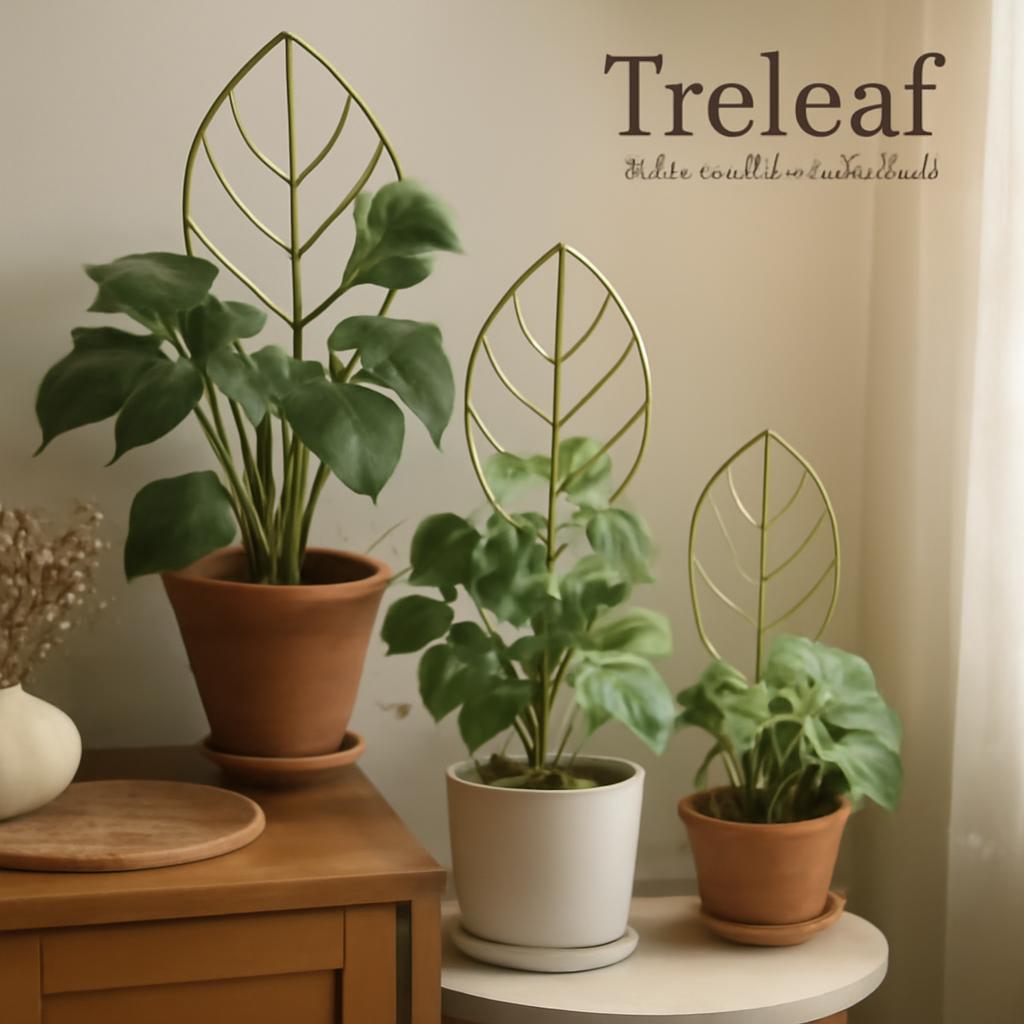
Treleaf is a woman-owned shop. The pieces are designed and finished in the United States, in a Georgia workshop, and they are meant for indoor pots. Most of the range is wood: leaf-shaped staked supports that go into soil, plank-style leans you can stack as a plant grows, and some wall clips for vines you want to run up plaster. I am not going to walk the whole catalogue. Two names are enough later. The rest is the same idea in different silhouettes.
A handmade trellis is a coat stand for a vine. The plant still needs something to lean on. You just do not want that something to look like a leftover from a grower's crate. Wood about a quarter inch thick, laser-cut, stakes coated so wet soil does not chew the base as fast. Water-based finishes. Indoor use only. If you put one outside, or in a wet medium it was not built for, the life of the piece shortens. The shop says that in plain language. I will not dress it up.
I looked for wood-species certificates, chain-of-custody stamps, the paperwork people wave when they want a product to sound official. Unpublished. I will not invent a species sheet or a forestry badge that the pages I read did not show. What they do say is hardwood plywood on the leaf shapes, cedar on the plank-style support, coatings chosen to resist moisture without pretending the wood is waterproof. Water-resistant is not the same as waterproof. Keep that in your head when you water.
Handmade here also means the usual workshop caveats. Grain will not match the photo. A faint scorch from the laser can show on an edge. That is listed, not hidden. If you want a factory-identical pair for two matching pots, you may be annoyed. If you can live with wood looking like wood, you will be fine.
Who should bother, after that warning
This is for someone whose climbing plant has started to flop and who does not want a moss pole or a green plastic ladder in the living room. It is for a gift buyer who already knows the recipient owns a Monstera or a Hoya and will not be thrilled by another watering can. It is for a renter who can use a stake in soil and cannot mark the wall. And it is for the person who will actually reseal wood once in a while, because a six-month warranty is not the same as a forever finish.
It is not for a balcony tomato. It is not for a landlord who says no holes, if the piece you clicked needs holes. Some Treleaf supports go in the pot. Some clip to a wall. Read the product line before you pay. I will name two in a minute so you can hear the difference.
- Skip it if a cheap stick from a garden centre is all the job requires.
- Skip it if your landlord forbids wall fixings and the piece you want is a clip set, not a soil stake.
- Skip it if the pot lives outside, or in a wet tray you never let dry.
- Skip it if you need two identical pieces and any grain shift will bother you.
- Skip it if forty-five dollars for a lean feels like a joke next to the cane by the compost bags.
Two names I will use, and no more
Zella is the cedar plank. It sits in the pot, you can add height as the plant grows, and people buy it when they are tired of moss poles. Regular sits around the forty-five-dollar mark. Taller kits and starter sets climb toward sixty-five dollars. A bundle with more than one size sat near one hundred twenty dollars when I looked, marked down from a higher figure. I am not going to recite every kit. If you need a lean that stays in soil and never touches the wall, start here.
Monstrella is the leaf. It is cut to look like a split-leaf silhouette, staked into soil on the regular and grande sizes. Regular stands about a foot above the soil. Grande is closer to two feet. Price on the staked leaf starts around forty-five dollars. There is also a wall-mounted version of that shape — clips and petite sets — and that is where the landlord problem comes back. If the listing talks about a wall, it needs a wall. If it talks about a stake, it needs a pot deep enough to take the spike.
I am stopping at those two. The shop has other leaf shapes. Naming them would turn this into a menu. If neither Zella nor Monstrella sounds like your plant, you can browse the rest without me inventing a favourite.
If the cane from the garden centre is doing the job, keep it. Treleaf is for the pot that sits where people walk past, and for the vine that needs a lean that does not look like hardware.
— Jordan Blake
A Sunday with a tape measure
I measured a pot on a Sunday because that is when I finally move the furniture. The hallway was packed — shoes, a drying rack, the usual Sunday mess — so I did the measuring on the floor by the door, not in some clean studio corner. Pot diameter first. Then the height of the plant as it stands now, not the height you hope it will be in a year. Then the gap between the pot and the wall. If that gap is a hand's width, a grande leaf will look crowded. If the pot is under four inches across, a staked leaf may not have enough soil to bite.
Push the stake in near the root ball, not through it. Leave the coated part in the wet zone and the finished face where you can see it. You do not have to tie every stem on day one. Let the plant find the wood. Soft ties help if a heavy leaf wants to flop. Do not crank them. And that's before you get to the wall clips, which are a different job: mark the plaster, check the lease, then decide if a soil stake would have been the saner buy.
- Measure the pot across, then the plant as it is today, then the space behind it.
- Pick a soil stake if the wall is off-limits; pick a clip set only if you may make holes.
- Seat the stake in soil, not through the thickest roots, and keep the coated length down where it stays damp.
- Use soft ties on heavy stems; leave slack so the wood does not cut the vine.
- Plan a look every six months: wipe, check the finish, reseal if the coat looks tired.
Open the shop, check which pieces are in soil versus on a wall, and decide if a handmade lean is worth more than a garden-centre stick.
See Treleaf's current indoor supports →How the order actually moves
You buy on treleaf.shop. The cart is ordinary: size, quantity, checkout. They take the usual card and checkout options a Shopify shop takes; I am not going to guess at every wallet logo. After you pay, the workshop side takes about three to five business days to process, weekends and holidays out. Then you get a shipped mail with a tracking number. Give the tracker a couple of days before you panic. If two weeks pass after that shipped mail and nothing shows, they ask you to write support@treleaf.shop with your name and order number.
Peak seasons slow the box. They say so. If you are buying a birthday gift, do not cut it to a week. Economy inside the lower forty-eight is the free lane on pieces Treleaf makes itself. Third-party add-ons in the same cart can ship apart and may carry their own fee. I did not build a mixed cart on the dated visit, so I will not pretend I watched that split happen. Read the line on the third-party page if you add one.
Returns start with an email, not a prepaid label in the box. Thirty days after the piece arrives. Unused, tags on, original packing, proof of purchase. If they accept the request they send a label and an address. Send it back without asking first and they will not take it. Exchanges sit in the same thirty-day window, and you pay the postage both ways. That last part is easy to miss when you are only thinking about the wood.
What you pay besides the trellis
The sticker on a regular staked leaf is about forty-five dollars. Zella lives in that same band unless you step up a size or a kit. Express inside the lower forty-eight is about twenty dollars if you do not want the free economy wait. International postage is calculated at checkout. Duties, VAT, whatever your country adds at the border — that is on you. Treleaf does not pick that tab up. I will not invent a duty table for a country I did not ship to.
Sales tax follows your address at checkout. I am not going to guess a rate. Gift wrap, if they offer it on a given week, is a line you can see before you pay. I did not see a published restocking fee on the return page I read. Unpublished, so I will not invent one. The cost that does show up later is resealing: a tin of exterior-grade lacquer or poly, which you already may own if you have ever touched outdoor furniture.
- Economy to the lower forty-eight, on Treleaf-made pieces: no extra shipping charge, about five to ten business days once it leaves.
- Express in those same states: about twenty dollars, one to four business days.
- International: postage shown at checkout, plus duty and tax your country may add after the box lands.
- Returns: thirty days if unused; they send a label if they accept the request.
- Exchanges: thirty days, and you pay postage both ways.
- Aftercare: a reseal every six months is on you, not on the shop.
Limits that do not vanish after checkout
Indoor only. Soil, not a mystery hydro setup. Moisture-resistant coatings, not a submarine. A six-month warranty if the piece fails in ordinary indoor use — write the same support address — and after that the wood is yours to keep dry and sealed. Laser marks can show. Colour can wander. Petite Monstrella in the staked line is gone; regular and grande remain. Stock on a handmade run can sit at zero. None of that is a scandal. It is a workshop selling wood into wet pots.
The other limit is taste plus money. You can train a vine on twine and a cheap cane and the plant will live. Treleaf does not make the plant healthier in a way I can prove. I will not claim bigger leaves, faster growth, or a happier home. The job is support that looks like it belongs next to a sofa. If that job does not matter in your room, the fee is a waste.
I also will not paste shopper praise. No star averages. No invented plant-parent notes about a trailing Pothos that finally felt loved. You can find customer photos on the shop if you want them. I am not going to ventriloquise them.
Will this even fit my pot?
A staked leaf wants a pot bigger than about four inches across, with enough depth for the below-soil spike — a few inches, not a finger of mix. Measure before you order. If the pot is a wide shallow bowl, a tall stake will look like a sail and may not hold. Zella wants a pot that can take a plank without tipping. If the plant is already top-heavy, add the support before the next growth spurt, not after the stem has gone sideways.
Do I have to drill the wall?
Not if you buy a soil stake. Yes if you buy a wall clip set. That is the whole distinction. A landlord who bans fixings is not a reason to skip every Treleaf piece. It is a reason to skip the wall line. Read the title. If it says wall, believe it. If it says stake or plank, you are working in the pot.
What if it arrives with a scorch mark?
A slight burn on a laser-cut edge is listed as normal and does not void the function of the piece. A chip, a crack, or a mark beyond ordinary grain is a different letter. They sell a separate B-stock lane for pieces with a known cosmetic fault. If you paid full price and the box looks like B-stock, write support with photos. I am not going to promise an outcome I did not watch.
Can I send it back unused?
Yes, inside thirty days, if you have not used it and you still have the packing and the proof of purchase. Email first. Wait for the label. Do not drop it at a courier counter on a guess. If you already seated it in wet soil, you are outside that unused rule. Warranty is the path for a defect, not for a change of mind after the stake has been in the pot.
Who pays if it crosses a border?
You do, if your country charges. They ship worldwide. Postage is in the cart. Import charges arrive later, from the carrier or the customs desk, and the shop says those are yours. If you live in the lower forty-eight and you are only buying Treleaf-made wood, the economy lane is free. Alaska, Hawaii, and territories are not that lane; I did not see a full rate card for those addresses on the pages I read, so treat that as unpublished and check the cart.
Is there a warranty, or do I just reseal it?
Both. Six months if the piece fails in ordinary indoor use. After that, and during that, they want you to look at the finish twice a year and add lacquer or poly if moisture is winning. The warranty is not a promise that wood will ignore water. Write support@treleaf.shop. They also answer Instagram and Facebook messages and say they reply within a day. I did not time a message on 27 September 2026, so I will not turn that into a stopwatch.
Confirm size, soil versus wall, shipping, and the thirty-day unused-return window before you pay.
Go to Treleaf's checkout →If the stick is enough, stop here
I keep coming back to the garden-centre stick because that is the honest competitor. Not another handmade brand. The stick. If it is holding the plant and you do not care how it looks from the hallway, you are done. Spend the forty-five dollars on soil or on a pot that does not tip. If you do care how it looks from the hallway, Treleaf is a workshop that will sell you a coat stand for a vine, ship it after a few business days, and ask you to keep the wood sealed. That is the offer. It is not a movement. It is a stake that cost more because someone in Georgia cut it to look like it belongs in a room.