The size dropdown almost got me
The first thing that went wrong was a size line. Not a coupon. Not a card that declined. A dropdown that read fifty by one hundred centimetres, which looks generous until you stand in a shower stall, hold your arms out, and realize you have priced a guest towel as if it were a bath sheet. I nearly bit on it. On 27 September 2026 the Cawö shop still lets you mix formats in one cart, and the photographs do not argue. They look soft. They do not tell you that a fifty-by-one-hundred is the cloth you hang for visitors, not the one you want after a long rinse.
Cawö weaves terry in Germany. The mill is in Emsdetten. The storefront at cawoe-shop.com is run by comwave, a mail-order firm in Dachau, which is a different building and a different inbox. That split matters when a box goes quiet, because you write to the shop, not to a loom. I kept one object in view the whole time I clicked: the size print on the product tile, the same line that later lands on a packing slip. The centimetres are the product. The photograph is decoration.
A short aside, then I will come back. Years ago I ordered a so-called bath sheet from a British catalog that arrived looking like a tea towel with ambition. Different brand. Different decade. I mention it only because Cawö's page will not break that habit for you. You still have to read the millimetres. The shop is good at showing color. It is average at saving you from your own eyes.
German terry, not a hotel giveaway
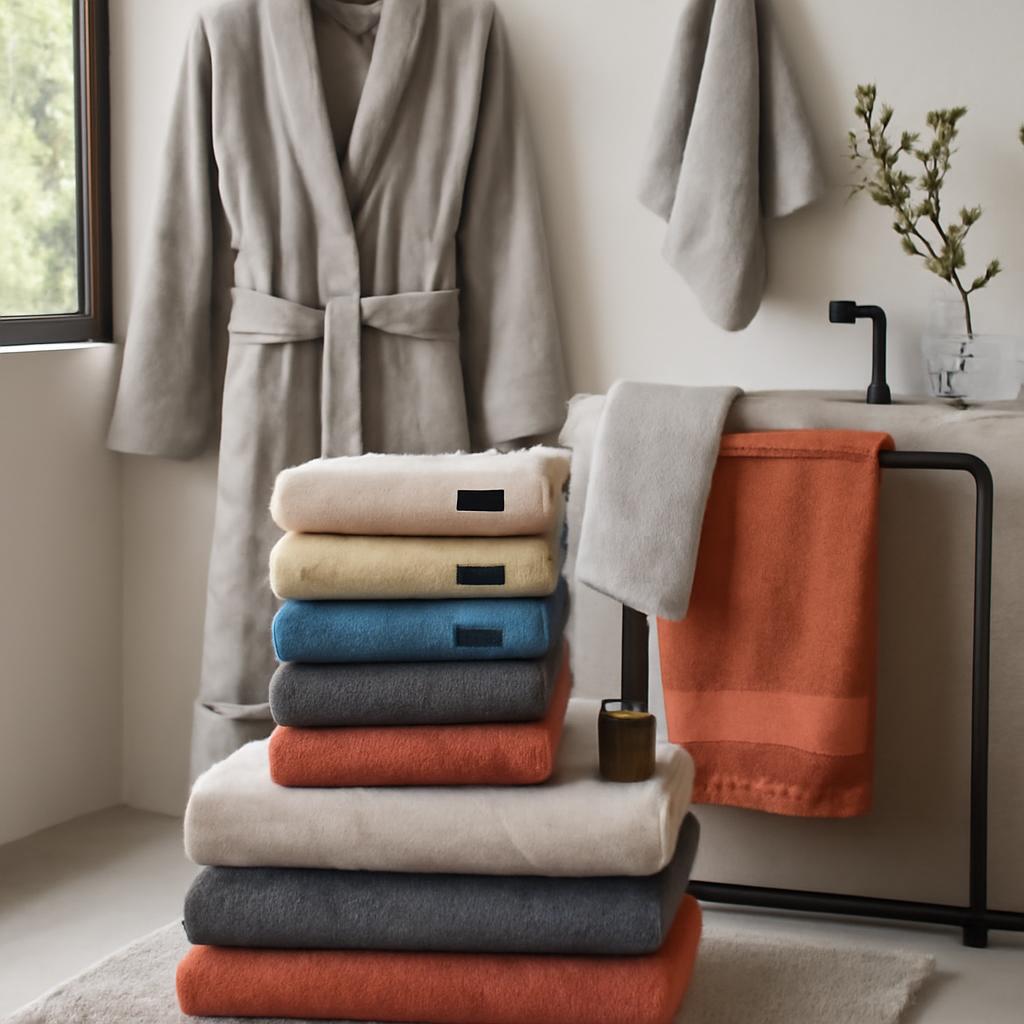
German terry — Frottier, if you want the word the mill uses — is cotton loops, not a printed beach rectangle. Cawö has been making that cloth since the late nineteen-forties. The loops are supposed to drink water and then let it go in a dryer or on a rail. Cheap terry pills, then goes board-stiff after a handful of washes. Better terry, if you do not drown it in softener, keeps some loft. I am skeptical of every sentence that treats a towel like a spa membership. A towel is a towel. The live question is whether you want one that still works in two winters, or a supermarket pack that already smells like the cupboard.
I think of good terry the way I think of a winter coat, not a paper napkin. You feel the weight. You pay once. You live with it through seasons. You do not get a napkin price, and you should not expect napkin timing. Catalog talk about everyday luxury does not help a person standing in a bathroom with a tape measure. Weight is whether the cloth can hold a shower's worth of water without turning into a sad flag.
The mill talks about cotton and, on many tiles, an Oeko-Tex line. I will not recite certificate numbers. If a finish matters to your skin, read the care icon on the tile you actually want. Unpublished claims help nobody. Most of the everyday ranges are cotton terry, made in Germany, sold from a wash cloth up to a sauna sheet.
Two names, then I stop
I will name two products and then I will stop, because a catalog dump is how these pages go bad. Lifestyle Uni 7007 is the plain, dyed cotton range near the top of the shop's bestseller strip. Smaller formats have been listed from about five euros. That is a guest-cloth number, not a shower-sheet number. Two-Tone Stripes 480 is the other name I am allowing: a striped series where the fifty-by-one-hundred has sat around eighteen euros, and the larger shower cloth around forty-eight euros. Same series. Different job. If your stall is tight, buy the smaller one. If you have room to turn on tile, buy the bigger one and stop pretending the guest size will grow.
Do I really need a fifty-by-one-hundred if the stall is already cramped? That is the question I said out loud, to an empty kitchen, before I touched payment. Robes exist in this shop too, often in the one-hundred-forty to one-hundred-sixty euro band. I am not naming them. A robe is a cut and a size chart, and those charts lie in the other direction — long in the sleeve, short in the back — if you guess.
Who should actually order here
This shop is for someone replacing a bathroom set on purpose, not on a Sunday night panic. You can wait a few working days. You care that the cloth was woven in Germany. You want a color that still exists next year so you can add a matching guest cloth later. You can read a German checkout, or you have a browser that will limp through the labels. Gift buyers who can ship to a German or nearby address fit. So do landlords refreshing a rental bath, if the budget is a set, not a single emergency cloth.
Keep going if you already own one Cawö piece and you want the rest of the rail to match. The series logic is the quiet strength. Same dye family, several sizes. That is how a bathroom stops looking like a rummage sale. It is also how a cart quietly climbs from eighteen euros to a number that makes you blink.
Skip it if you need a supermarket towel tonight
Walk away if any of the next lines sound like you. I am not being cute. The shop cannot hand you a folded cloth at eight o'clock. There is no counter in Emsdetten for this cart, and the terms are blunt about pickup: it is not offered.
- You need a supermarket towel tonight, because guests are already on the train and the rail is empty.
- You refuse to read centimetres and will buy from the prettiest photo.
- You want to collect a parcel at the mill or at the Dachau office this afternoon.
- You need a custom monogram in forty-eight hours, or a sealed hygiene item you plan to open and still send back as new.
- You live outside the European Union and you have not budgeted for duties, bank fees, or a withdrawal rule that may not apply to you.
- You only pay in cash at a till and you will not use a card, a transfer, or PayPal.
If you are still here, you are the person who can let a box sit two or four extra days because you live in Italy or Spain, not next to a German depot. That wait is not a scandal. It is geography. The shop publishes extra days on a country table. I checked that table on the same Sunday. Austria added about a day. France and the Netherlands added about two. Greece added about six.
How the German checkout really works
You put cloth in a cart. You walk a German form. You hit the button that binds you. Under the published terms, that click is your offer. comwave can take it within five days by sending a confirmation, by shipping the goods, or by asking you to pay. PayPal is the exception that accepts at the click, if you actually pay that way. The contract language is German. The order text is stored and mailed. If you made an account, you can reopen the history. If you did not, keep the email.
The till, on the pages I could read, has shown cards, PayPal, prepayment, and invoice options, with PayPal able to run a credit check when the shop is the one waiting for money. Cash on delivery appears in older writeups. I will not treat those as a live price list. Look at the radio buttons in your own cart. Delivery goes to the address in the form, except PayPal, which uses the address sitting in PayPal. Failed delivery that is on you can leave you with reasonable extra costs. That is why a wrong buzzer code is more expensive than it looks.
In-stock tiles often show one to three working days inside Germany, then you add the country extras. The shop's own clock is the one on the tile, not a promise from me. Sunday measuring in a rental hallway will not make the parcel service faster. I say that as someone who has stood in a hallway with a tape and a phone, which is a foolish place to hurry a checkout.
Read the centimetres on the tile, then use the German checkout if a parcel in a few days still works for you.
Open the Cawö shop →Fees, said in words
Here is where I got irritated, and I will say it once. Freight is the part every pretty towel site shrugs at until the total jumps. Third-party pages still quote about five euros for a German or Austrian parcel from this shop. On my 27 September 2026 pass, the shop's own shipping page did not publish a clean standalone figure I would treat as gospel, so I am leaving the exact outbound fee unpublished and telling you to read the cart. Do not trust a recap for the last line of a total.
- Outbound parcel inside Germany or Austria: often described as about five euros; confirm the live line before you pay.
- Extra country days: add the published table (about a day for Austria, about two for France or the Netherlands, about four for Italy or Spain, about six for Greece) on top of the tile's own clock.
- Statutory withdrawal: you pay the direct cost of sending the cloth back; they refund the goods and the cheapest outbound postage they offered, not a rushed upgrade you chose.
- Hundred-day exchange: you stamp the box, you carry the transit risk, and they will not take an unfranked parcel.
- If the swap item costs more: the difference is a bank transfer they name by email, not a second PayPal tap.
- Outside the EU, or paying from outside the EU: duties, bank fees, and currency charges sit on you. The shop says so.
Prices on the tiles already include German VAT. That is the easy part. The hard part is the last kilometre and the way back. I would rather you over-budget a few euros than invent a free-return fantasy the form never promised.
Two clocks: fourteen days and one hundred
Consumers in the EU get the usual fourteen days from the last item arriving, no reason required. You tell comwave — email is enough, and there is also an on-site withdraw page that sends a receipt. Then you have fourteen days to send the goods to the logistics desk in Salzweg, not to Emsdetten. You pay that postage. They can hold your refund until the box is back or you prove you sent it. Use that goes past a reasonable check can cost you value. Sealed hygiene goods lose the right if you break the seal. Custom pieces can sit outside the right from the start. Non-EU buyers with a non-EU address may not have this right at all.
Separate from that, the shop advertises a hundred-day exchange. That clock starts the day after the goods arrive. The cloth has to be unused, complete, and in the original pack if it came in one. You download an exchange-return form, fill it, and post the lot, stamped, to CS Logistik in Salzweg. If you forget the form during the legal window, they may treat the box as a withdrawal instead. That is the rub. Exchange is a courtesy with homework. Withdrawal is the statute. Mix them up and you stamp a parcel that does the wrong job. If the new piece costs more, only a bank transfer closes the gap. Read the form. It is clearer than the marketing strip.
What the shop will not do
No counter pickup. The terms say so for logistics reasons, which is a polite way of saying the warehouse is not a showroom. No promise that every color in a series is in stock on the same day. No English-language contract. No overnight supermarket run. And no, wrapping yourself in a Cawö cloth will not fix a leaky tap. I am not going to pretend a towel is a renovation.
Defect rights are the other track. If the cloth arrives faulty, that is not a fashion return. Write the desk. Keep photos of the packing slip and the fault. I am not going to invent a case I did not open. Unpublished outcomes stay unpublished. The legal warranty is not the hundred-day form, and the hundred-day form is not a warranty.
Read the centimetres on the packing slip before you fall for the photograph. Cawö will sell you German terry. It will not stop you ordering the guest size.
— Noah Bennett
Wash it like cloth, not like a costume
Most of the everyday Cawö tiles I opened asked for a sixty-degree wash, no bleach, a low dryer, no iron, and no dry cleaner. Softener is the quiet wrecker. It leaves a film that makes loops lazy, which is how a thick towel starts skating water off your arms. Shake the cloth before it goes in and after it comes out. Air-dry if you are patient. Low heat if you are not. I am not handing you a spa ritual. I am telling you how cotton loops die.
If a series page disagrees with that sixty-degree habit, obey the series page. A stripe or a special finish can be fussier than a plain dye. The packing slip and the sewn-in label beat any recap, including this one. When those two fight, the label on the cloth wins after it arrives.
Questions I would ask out loud before I pay
Is cawoe-shop.com the mill? No. Cawö weaves in Emsdetten. comwave sells. Write the shop inbox on weekdays if the box is the problem. The public address on the exchange form is CS Logistik in Salzweg, care of comwave. The legal seller sits in Dachau. Three places, one brand name on the hem.
Can I pick the order up? No. The terms close that door. If you need cloth tonight, this is the wrong shop, and I already put the supermarket line at the top of the skip list on purpose. A same-day rail is a different errand.
Who pays to send a towel back? On a normal withdrawal, you do. On the hundred-day exchange, you also stamp it, and you carry the risk in transit. Do not send it unfranked. They say they will not take that box. Refunds, once they have the goods or your proof of post, are supposed to travel back on the same rail you used to pay.
What if I used it once to see the feel? Then you are probably outside the exchange rules, and you may owe value on a withdrawal if you went past a reasonable check. A shower is not a check. A hand on the hem is. Buy one cloth first.
How long to Italy or Spain? Take the tile's German clock, then add about four days from the published table I saw. Greece added about six. That is a maximum extra, not a guarantee that your street is easy.
What if the swap costs more? They email a bank account. You send the difference first. Other rails are not offered for that gap. If that sounds like a faff, stay inside the fourteen-day withdrawal and buy the right size clean. The hundred-day clock is for unused cloth you still have in the bag.
Do I need a German bank account to place the order? No. Cards and PayPal are the usual path. A German account only becomes the story if you are paying an exchange difference or you chose prepayment. Keep the confirmation mail.
If a German parcel still beats a thin supermarket pack, open the shop and read the size line twice.
Check Cawö sizes →