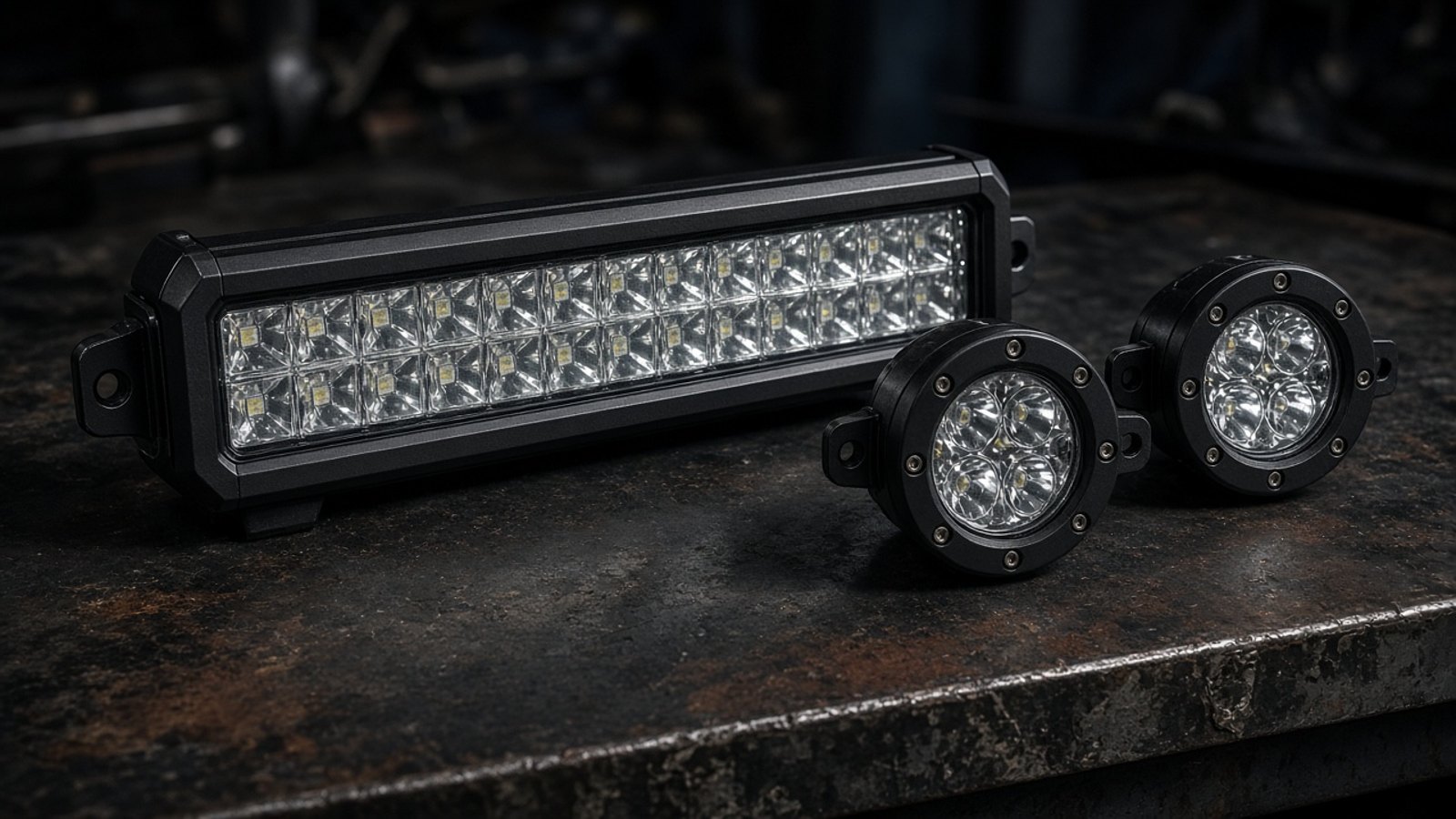
A brighter beam is not a legal beam
I opened auxbeam.com because a work truck and a trail rig are not the same electrical problem, and people shop them as if they were. The public description calls the shop a maker of LED lighting for off-road, industrial, and similar hard use, and it names light bars, headlight bulbs, driving lights, work lights, and lights for motorcycles. I am not going to walk that grid. The purchase is a lamp or a switch, a wire, and a vehicle that has to remain legal on the road it actually uses.
Brightness is the easy boast and the one I will not repeat as a number. I did not copy a lumen figure, a watt figure, or a price. On 25 August 2026 those belong to the product page. What I will talk about is the beam you are allowed to show other drivers, the wiring that keeps the lamp from becoming a short, and the fact that a light you have already mounted is a miserable return.
I did not install a bar, aim a headlamp, or load a switch panel until a fuse gave up. Anyone who wants a tidy certification from me does not get one. If the page claims a compliance mark, read the mark. If it says off-road, believe it when the tyres are on a public road.
Who should be holding the connector
Buy here if you already know the lamp's job. A work light for a job site where the vehicle is not in traffic. A light bar for trails, used where a light bar is allowed. A headlight bulb only if you know the beam has to be aimed and the housing is the one the bulb claims to fit. You can use a fuse. You can put a panel back together. You will read the return rule before you drill a hole you cannot undrill.
It is the wrong shop if you want a plug that makes a family car look like an emergency vehicle. Colours and patterns that imitate emergency lights are a legal problem, not a style. I will not help you choose one. It is also the wrong shop if you hate wiring and hoped the word LED meant no wire. A bulb in a housing still needs the housing to be the right one. A bar needs a bracket, a switch, and a path back to the battery that does not melt.
Leave if the vehicle is under a warranty you do not understand, or a lease that forbids holes. A switch panel is a set of decisions about current. If you cannot say what each switch will feed, you are decorating the dash.
- You want a road-legal verdict this article cannot sign.
- The page says off-road and you plan to use it in traffic.
- You will drill or splice before you read the return rule.
- You want a lumen or a price copied from this piece.
If the job is real, the next page has to say what the beam is for, how it is wired, and whether an installed lamp can come back.
Read off-road versus on-road use, and the fitment, before you add a switch panel.
Open the Auxbeam page for that lamp →Beam, then wire, then the hole
Read the use line before the brightness line. Off-road, work, driving, fog, headlight: these are different beams. A headlight has to put light on the road without throwing it into the eyes of the person coming toward you. A light bar is often sold for places that are not a highway. If the page says off-road use, that is the maker telling you not to treat it as a headlight. Local rules decide the rest. I am not your local rule. On 25 August 2026 I would open the vehicle's own lighting rules, or a source that actually states them, beside the product page. A product photo is not a statute.
Fitment is the boring line that saves the order. A bulb has a base. A housing expects that base. A bar has a width and a bracket. If the page does not name the base or the width, that fact is unpublished and you are guessing with a drill. Do not guess the base from a shape in a thumbnail. Write down the bulb you are replacing, from the lamp you remove, not from memory.
Wiring is part of the object even when it arrives in a separate bag. The page or the manual should say how the circuit is protected: a fuse, near the power source, and a wire that can carry the load. I will not name a gauge or a fuse size. Those numbers are unpublished here because I will not invent them, and the wrong invented number is how looms melt. If the manual is not on the page, you do not have a manual. Disconnect the battery before you touch a live stud. That is ordinary workshop practice, not a personality.
A switch panel is a small dashboard of future mistakes. Each switch needs a load that the panel can feed, a label you will understand at night, and a fuse that is not a paperclip. If you do not know the load, do not buy the panel because it has more switches than you have ideas. Installed means holes. Holes are the return problem, which belongs in the money section and also belongs here, before you fall in love with a render.
Installed lights are a different purchase
No price. Lamps go on promotion and the promotion is not a specification. On 25 August 2026 the basket after the address is the spend, including a heavy bar that may not ship like a bulb in an envelope. Read that difference. A bulb and a bar are not the same freight, and I will not guess which one is dearer to send.
The return that matters is the one after installation. A lamp you have mounted, aimed, spliced, or stuck down with sealant is used. A harness you have cut cannot be uncut. I do not have Auxbeam's window or their exception for installed goods. Assume the answer is no until the policy says yes in writing. Test what you can test before you drill: the connector on the bench, the bulb in the housing if it comes out without breaking a clip, the switch with a fuse and no new holes. If a test requires a hole, you are past the easy return.
A failed lamp on a work truck is downtime, not only a refund. Keep the order mail and the manual in the glove box, not in a download folder you will not find on the shoulder of a road. Warranty exclusions for water, for reverse polarity, and for a relay you bypassed are the exclusions that actually happen. If the page does not list them, the warranty detail is unpublished. Do not fill it with optimism.
- Read the use line, off-road or on-road, before the brightness.
- Match the bulb base to the housing in your hand.
- Do not drill until the return rule is read.
- Take fuse and wire size from the manual, not from memory.
What I will not sign off
I will not tell you a beam is legal on your road. Legality is the local rule plus the way the lamp is aimed. A compliant bulb in a filthy, crooked housing still glares. A light bar wired to a high beam switch can still be the wrong lamp for a public road. If you blind oncoming traffic, the argument that the website used the word driving will not help you. Aim the lamp. If you cannot aim it, do not fit it.
I will not quote lumens, colour temperature, or a weatherproof rating. Those figures were not copied into this piece. A bigger number is not a better beam. Pattern, cutoff, and aim are the beam. A work light that floods a job site is a poor headlight. Use it as a work light.
Water gets into connectors that looked fine in the photo. Vibration on a work truck loosens a bracket the first week. I did not shake a bar for a week. Torque the hardware, use the fuse, and do not run a new circuit through a grommet you sliced with a knife and forgot to seal. If you do not know how to do that, this is a job for a shop that wires vehicles, not a Saturday of hope. Their labour is a real cost and it is unpublished here.
I would buy an Auxbeam lamp only for the use the page actually names, with the wiring taken from the manual and the holes drilled after I had read the return rule. I would not put an off-road bar on the public road and call it a headlight.
— Sophie Winters
Before the drill comes out
Is a light bar legal on the road?
Often the page says off-road. Believe that until a local rule you have actually read says otherwise. I will not certify a bar for your commute. Aimed headlights and a legal beam are a different product decision.
Can I copy a wiring diagram from a forum?
Use the manual for the lamp you bought. A fuse size or a wire size I did not print is not a suggestion. If the manual is missing, do not invent the circuit.
What if I mount it and hate it?
Assume an installed, drilled, or spliced lamp cannot come back. Read the policy first. Bench-test what you can. Holes are the point of no return.
Will a brighter bulb fit my housing?
Only if the base matches and the beam can be aimed in that housing. Take the old bulb out and read it. A thumbnail is not a base code.
Do the switch panels include the lights?
Read the variant. A panel, a harness, and a bar can be three purchases. I am not guessing what the kit contains. The box contents on the page are the contents.
Manual open, drill still in the drawer
Pick the lamp whose page names the job, match the base or the bracket to the vehicle, and read the return rule with the drill still put away. Wire it the way the manual says, fuse included, battery disconnected while you work. Aim it before you drive toward another person.
On 25 August 2026 lumens, price, and the legal status of your particular road were unpublished. They can stay unpublished here. The page and the local rule are shorter than the regret of a hole in a panel you cannot return.
Confirm off-road or on-road use, the bulb base, and the return rule before you drill.
Read the Auxbeam use line →

